
The Physical Risk Intelligence Platform Built on a Proven Methodology
Circadian Risk is the only platform that takes organizations through a structured, repeatable process from inherent risk through controls assessment to a quantified residual risk score, across every location, every scenario, and every day.
Trusted by Businesses Worldwide

Physical Risk Intelligence Starts with a Framework, Not a Checklist
Most physical security assessments produce a narrative report. They describe what was observed, note what is deficient, and recommend corrective actions. That report sits in a folder, gets presented to a board once a year, and is largely forgotten until the next assessment cycle begins.
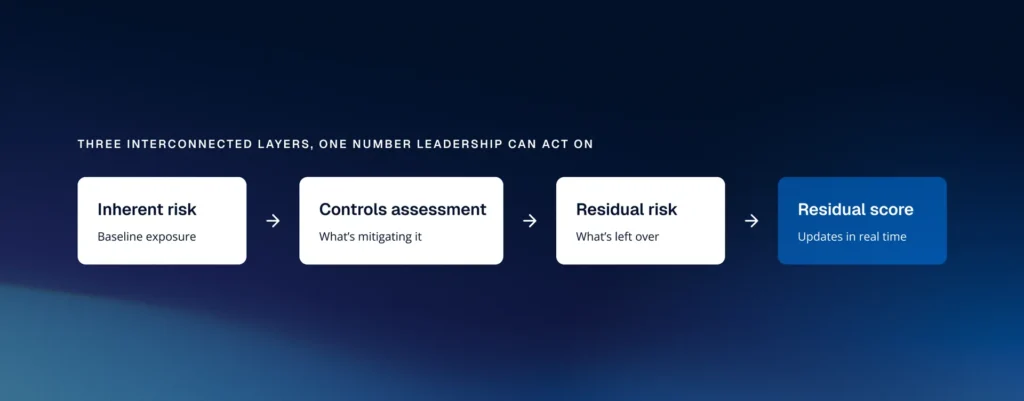
Circadian Risk was built on a fundamentally different premise. Physical risk is not a static condition to be documented. It is a dynamic, measurable variable that changes as threats evolve, controls degrade, and organizational exposure shifts. The only way to manage it effectively is to quantify it, monitor it continuously, and connect every remediation action directly to a risk score that updates in real time.
The Circadian Risk platform does exactly that. It is built around three interconnected layers: inherent risk, controls assessment, and residual risk. Together, they convert raw physical security data into a number that security leaders, risk officers, and executives can act on with confidence.
How the Circadian Risk Platform Calculates Physical Risk
Step 01
Inherent Risk — Understanding the Threat That Already Exists at Every Location
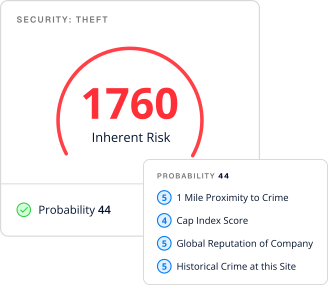
Before installing a single camera or deploying a single guard, every location already carries risk. That risk is determined by where the location exists and what it does: the local crime environment, the nature of the organization, the characteristics of the surrounding area, and the probability and severity of various threat scenarios at that specific site. Circadian Risk’s Dynamic Threat and Impact Assessment quantifies that baseline risk for every scenario independently. Active shooter risk is calculated differently than flood risk. Theft risk is calculated differently than compliance failure. The variables that drive probability and severity are scenario-specific because the threats are fundamentally different. The result is an inherent risk score for every location, for every scenario, before considering any controls.
Step 02
Controls Assessment — Mapping Every Physical Security Countermeasure at Every Location
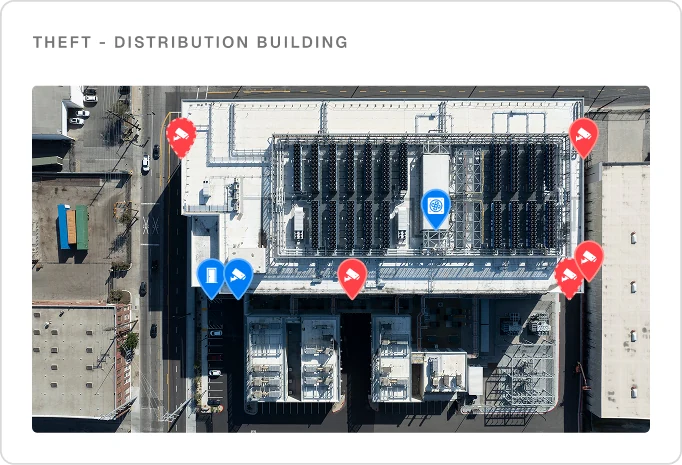
Once inherent risk is established, the platform measures what an organization has in place to address it. Circadian Risk’s Visual Vulnerability and Inventory Assessment gives assessors a floor plan or map-based interface where every physical security countermeasure can be documented: cameras, access control systems, fire suppression equipment, bollards, lighting, guard stations, and any other asset relevant to the scenario being assessed. Every countermeasure is evaluated for compliance, deficiency, or absence. The result is a complete, scenario-specific picture of what works, what doesn’t work, and what is missing entirely. This inventory becomes the organization’s single source of truth for physical security assets across every location in its portfolio.
Step 03
Residual Risk — The Number That Tells Security Leaders Where to Act
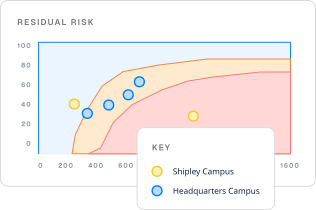
Inherent risk minus the effect of controls equals residual risk. Circadian Risk calculates that number for every location, every scenario, and every assessment cycle, and displays it on a real-time dashboard that lets security leaders compare locations side by side, identify the highest-risk sites, and prioritize remediation with precision. Residual risk is not a static score. When a deficiency is resolved, the score updates automatically. When a new threat emerges, the score reflects it. Security leaders always know where their organization stands, not where it stood six months ago when the last report was written.
Five Integrated Capabilities That Power the Physical Risk Intelligence Platform
Each capability within the Circadian Risk platform is purpose-built to address a specific layer of the physical risk intelligence process.

Dynamic Threat and Impact Assessment
Evaluate the probability and severity of every threat scenario at every location based on site-specific variables. Establish a defensible, quantified inherent risk score that serves as the foundation for every downstream decision.

Visual Vulnerability and Inventory Assessment
Map every physical security countermeasure at every location on an interactive floor plan or site map. Identify compliant assets, deficiencies, and missing controls across every scenario, and build the organization’s single source of truth for physical security inventory.

Residual Risk Dashboard
Monitor quantified residual risk scores across every location and scenario on a single real-time dashboard. Compare sites, identify outliers, track improvement over time, and generate board-ready reports at the click of a button.

Risk Remediation and Task Management
Convert every deficiency identified in an assessment into a trackable, assignable remediation task. Notify responsible parties automatically, monitor completion status, and watch residual risk scores update in real time as deficiencies are resolved.

Scenario-Based Risk Modeling
Assess physical security risk across every relevant threat scenario independently: active shooter, workplace violence, theft, natural hazards, compliance failure, and more. Because countermeasures are scenario-specific, each scenario is modeled and scored on its own terms.

A Physical Risk Platform Built on ASIS International Standards
Circadian Risk is a partner of ASIS International, the world’s largest organization for security management professionals. The Circadian Risk platform converts ASIS standards directly into structured assessments, giving every risk program a defensible, internationally recognized foundation. Whether the assessment framework is the Physical Asset Protection standard, the K-12 school security standard, or a client’s own internal standard, the Circadian Risk platform can build it, run it, and score it.
Frequently Asked Questions About the Circadian Risk Platform
What is the difference between inherent risk and residual risk in physical security?
Inherent risk is the level of risk that exists at a location based on its environment and characteristics, before any security controls are in place. Residual risk is what remains after the effect of those controls is factored in. Circadian Risk calculates both, giving security leaders a precise picture of how much risk their current program is actually reducing and how much remains unaddressed.
How is Circadian Risk different from a traditional physical security assessment tool?
Traditional assessment tools are designed for the assessor: they capture data, generate reports, and deliver findings. Circadian Risk is designed for the decision-maker. It converts assessment data into a quantified risk score, monitors that score continuously across all locations and scenarios, and connects every remediation action directly to a measurable reduction in residual risk. The outcome is not a report. It is a live risk intelligence system.
Does Circadian Risk support multiple locations and multiple scenarios simultaneously?
Yes. The platform is built specifically for multi-location organizations. Security leaders can view residual risk scores for every location, for every scenario, on a single dashboard, making it possible to compare sites, identify priorities, and allocate resources based on where risk is actually highest.
How does the ASIS International partnership affect the platform's assessments?
As a partner of ASIS International, the Circadian Risk platform can convert ASIS standards directly into structured assessment frameworks. This means every assessment built on the platform can be grounded in internationally recognized security standards, giving organizations a defensible, audit-ready foundation for their physical risk programs.
See the Physical Risk Intelligence Platform in Action
Walk through the full Circadian Risk platform with a member of our team. See how your organization’s risk program would look when inherent risk, controls, and residual risk are all connected in one place.