
Know the Risk That Exists Before Any Controls Are in Place
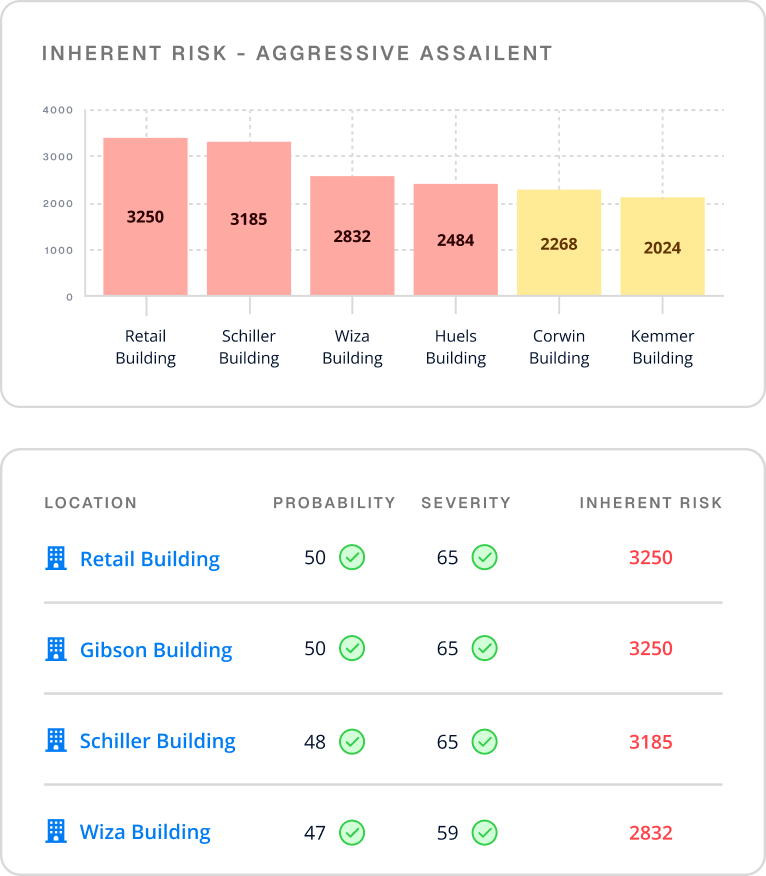
Before a camera is installed or a guard is deployed, every location already carries risk. Circadian Risk’s Dynamic Threat and Impact Assessment quantifies that baseline risk for every scenario, at every location, so security leaders always know what they are actually working with.
What Is Inherent Risk in Physical Security, and Why Does It Matter?
In physical security, inherent risk is the level of threat exposure that exists at a location based purely on its environment and characteristics, before any security controls are factored in. It reflects the reality that some locations are simply more exposed to certain threats than others: a distribution center in a highcrime area carries more inherent theft risk than a corporate office in a low-crime suburb. A facility on the Gulf Coast carries more inherent hurricane risk than one in the Rocky Mountains. That baseline exposure exists whether or not the organization has done anything to address it.
Most security programs skip this step entirely. They go directly to identifying deficiencies, deploying countermeasures, and checking compliance boxes without ever establishing a quantified baseline of what the threat environment actually looks like at each location. The result is a program that measures activity but not risk, and that cannot tell leadership whether the resources being invested are going to the right places.

Why Inherent Risk Must Be Assessed Scenario by Scenario
The Problem with General Security Assessments
Most organizations conduct a single general assessment for each location. It covers all threats at once, applies the same evaluation criteria to every scenario, and produces a combined score or report that treats a fire risk and an active shooter risk as if they were governed by the same variables. They are not.
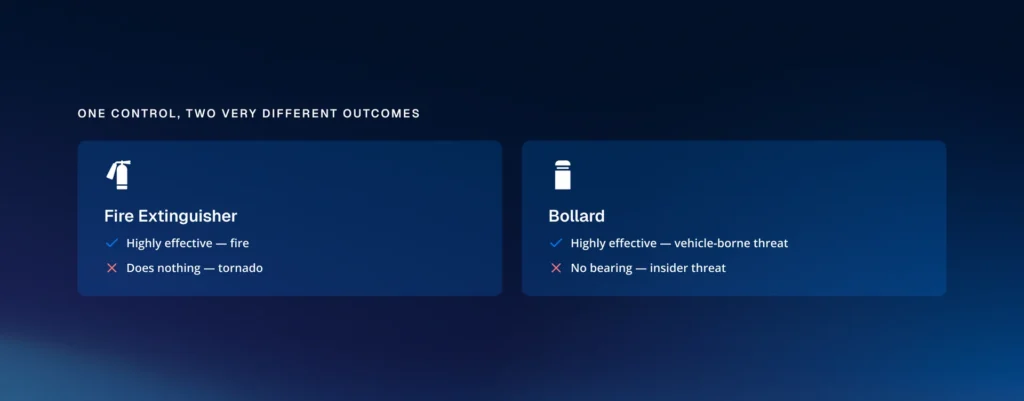
A fire extinguisher is a highly effective countermeasure for fire risk. It does nothing for a tornado. A bollard is effective against vehicle-borne threats. It has no bearing on an insider threat scenario. The controls that reduce risk are scenario-specific because the threats themselves are fundamentally different in nature, probability, and severity
Circadian Risk assesses inherent risk independently for each scenario because the variables that determine probability and severity are different for each one. An active shooter assessment weighs factors like organizational controversiality, workforce size, termination history, and proximity to high-stress environments. A flood assessment weighs geographic location, elevation, proximity to waterways, and historical weather patterns. Measuring them with the same instrument produces data that is at best incomplete and at worst misleading.
How Physical Risk Intelligence Works
Physical risk intelligence starts with a framework. Circadian Risk’s platform is built around three interconnected layers that take organizations from raw assessment data to a quantified, actionable risk score.
Step 1 — Probability Assessment
For each scenario, Circadian Risk evaluates the variables that determine how likely a threat event is to occur at that specific location. These variables are scenario specific and site-specific, drawing on factors including local crime data, organizational characteristics, geographic exposure, and demographic context. Each variable is weighted and scored to produce a probability rating for that scenario at that location.
Step 2 — Severity Assessment
Probability alone is not enough. Circadian Risk also evaluates how severe the impact would be if the event were to occur. Severity factors include operational disruption, financial exposure, reputational impact, employee safety consequences, and regulatory liability. A low-probability event with catastrophic severity demands a different response than a high-probability event with contained impact.
Step 3 — Inherent Risk Score
Probability multiplied by severity produces the inherent risk score for that scenario at that location. This score is fully quantified, scenario-specific, and comparable across every location in the organization’s portfolio. It becomes the baseline against which every security investment and every control assessment is measured.




Fully Customizable to Your Organization's Variables and Standards
Circadian Risk’s inherent risk variables are built by a team of security analysts and researchers, but they are fully customizable. Organizations can adjust variables, add their own risk factors, and incorporate internal standards or industry-specific frameworks. Circadian Risk is also a partner of ASIS International, converting ASIS standards directly into inherent risk assessment frameworks within the platform.
Inherent Risk Is the Starting Point. Controls Assessment Is What Comes Next.
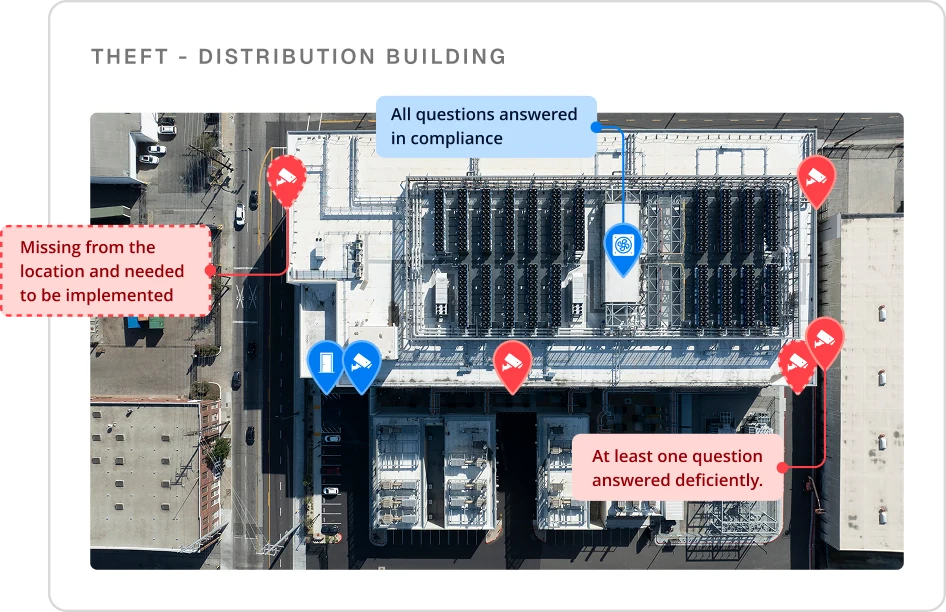
Once inherent risk is established for every scenario at every location, the next question is: what does the organization have in place to address it? Circadian Risk’s Visual Vulnerability and Inventory Assessment maps every physical security countermeasure at every location, evaluating each one for compliance, deficiency, or absence against the specific scenario being assessed.
Frequently Asked Questions About Physical Security Inherent Risk Assessment
What is inherent risk in physical security?
Inherent risk in physical security is the level of threat exposure that exists at a location based on its environment, characteristics, and context, before any security controls or countermeasures are considered. It represents the baseline risk that an organization is exposed to simply by virtue of where a location exists and what it does. Circadian Risk quantifies inherent risk for every threat scenario independently, producing a scored baseline that serves as the foundation for all downstream risk management decisions.
Why does Circadian Risk assess inherent risk separately for each scenario?
Because the factors that drive risk are different for every threat type. The variables that determine the probability and severity of an active shooter event are not the same as those that determine flood risk or compliance failure risk. Applying a single general assessment to all scenarios produces data that cannot accurately reflect the actual risk environment. Circadian Risk assesses each scenario independently so that the resulting scores are precise, defensible, and actionable.
How is Circadian Risk's inherent risk assessment different from a standard risk assessment?
A standard risk assessment typically identifies vulnerabilities and deficiencies at a location. Circadian Risk’s inherent risk assessment establishes a quantified baseline of threat exposure before any controls are considered. This distinction matters because it tells security leaders not just what gaps exist, but what the underlying risk environment looks like at each location, enabling them to prioritize resources based on actual exposure rather than observed deficiencies alone.
Can organizations customize the inherent risk variables used in the assessment?
Yes. Circadian Risk’s assessment framework is fully customizable. Organizations can modify existing variables, add proprietary risk factors, and incorporate internal standards or industry-specific frameworks. As a partner of ASIS International, Circadian Risk can also convert ASIS standards directly into structured inherent risk assessment frameworks within the platform.
See How Circadian Risk Quantifies Inherent Physical Security Risk Across Your Portfolio
Walk through the Dynamic Threat and Impact Assessment with a member of our team. See how your organization’s inherent risk profile would look across every location and every scenario.