
Document Every Countermeasure, Identify Every Gap
Circadian Risk’s Controls and Vulnerability Mapping module gives security teams a visual, map-based platform to document, evaluate, and track every physical security countermeasure at every location, producing a complete, scenario-specific picture of what is working, what is deficient, and what is missing entirely.
Why Physical Security Vulnerability Mapping Needs to Go Beyond the Checklist
Physical security vulnerability assessments have traditionally been conducted with paper forms, spreadsheets, or basic digital checklists. An assessor walks a location, notes what is present and what is deficient, writes a report, and submits it. That report may take weeks to produce, may reflect conditions that have already changed, and almost certainly cannot be easily compared to assessments from other locations in the portfolio.
The deeper problem is that most assessments evaluate countermeasures in aggregate rather than against specific scenarios. A camera that covers a loading dock contributes to theft risk reduction. It contributes nothing to compliance with a Joint Commission healthcare standard. Evaluating that camera as simply present or absent without connecting it to the scenarios it actually affects produces a count, not an intelligence layer. Circadian Risk’s Controls and Vulnerability Mapping module is built to produce intelligence.

How Circadian Risk Maps Physical Security Controls and Vulnerabilities
Step 1 — Map Your Location on an Interactive Floor Plan or Site Map
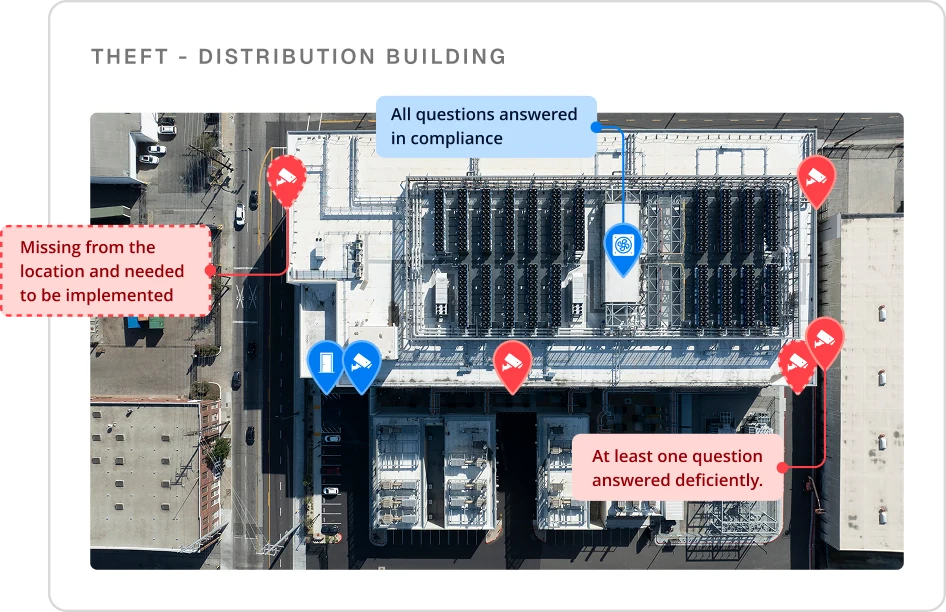
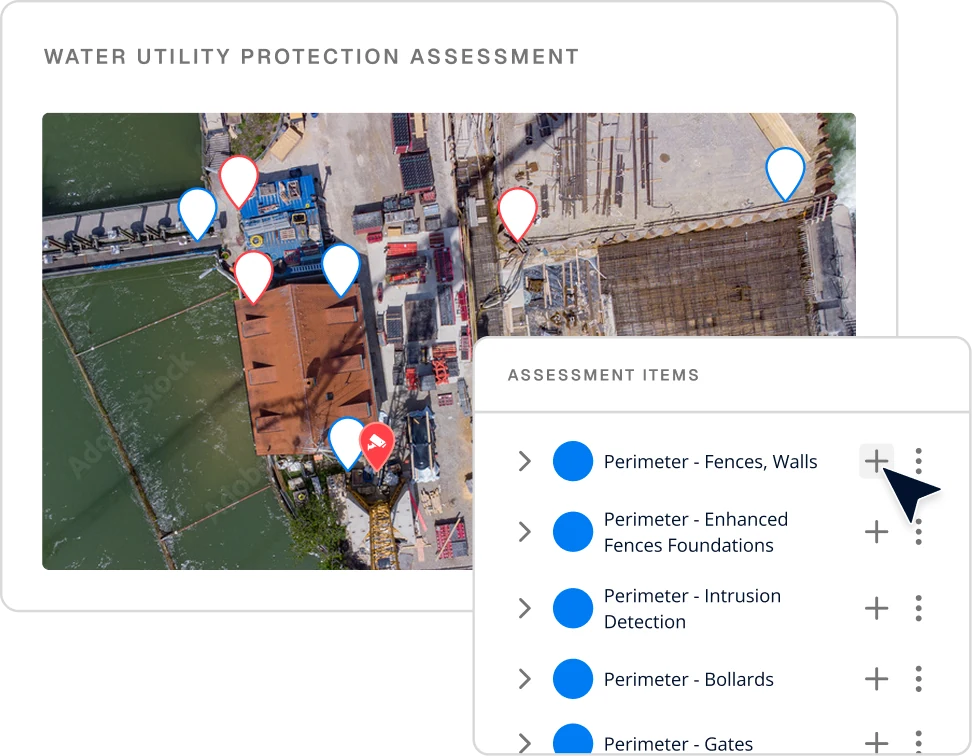
Assessors begin by loading a floor plan, building layout, or Google Maps view of the location being assessed. Every physical security countermeasure, cameras, access control systems, bollards, fire suppression equipment, lighting, guard stations, and any other relevant asset, is dragged and dropped directly onto the map at its actual location. The result is a visual, spatially accurate record of the physical security infrastructure at that site.
Step 2 — Evaluate Every Asset Against the Scenario Being Assessed
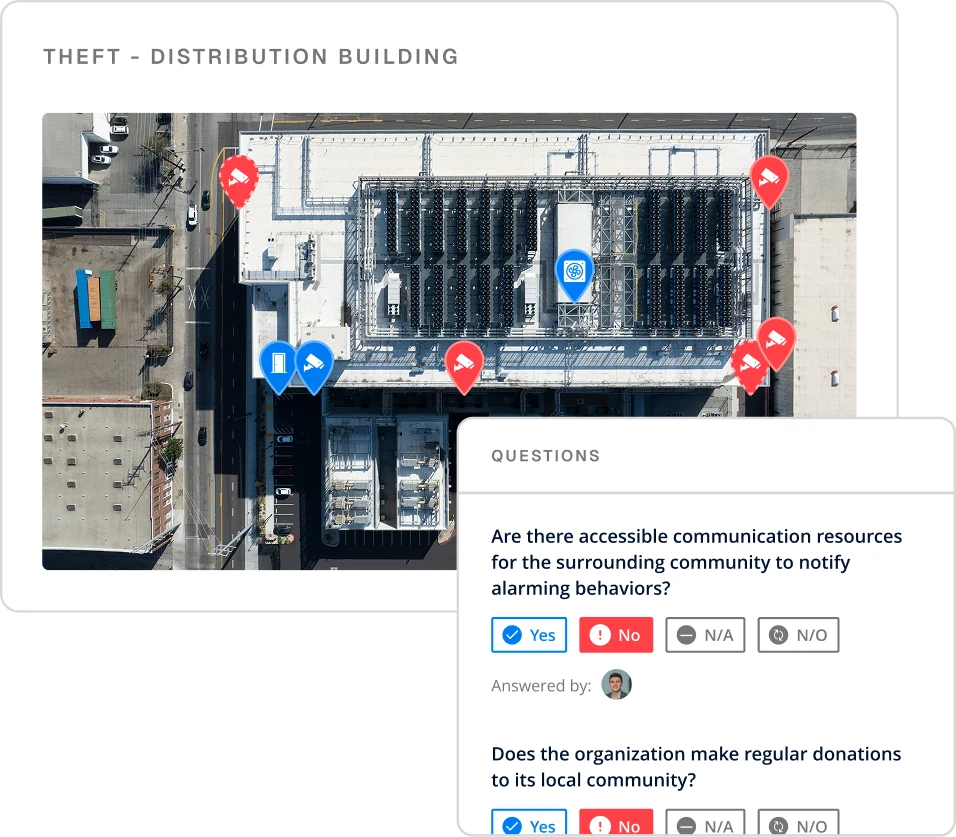
Each countermeasure is evaluated not just for presence, but for condition and effectiveness relative to the specific scenario being assessed. Assets are classified as compliant, deficient, or absent. A deficient asset exists but does not meet the standard required for the scenario. An absent asset is needed but not present. This distinction matters because a deficient camera and a missing camera represent different remediation priorities and different cost implications.
Step 3 — Build the Organization's Single Source of Truth for Physical Security Assets
Every asset documented across every location and every assessment populates a central inventory. Security leaders can answer basic but critical questions with precision for the first time: how many cameras does the organization have in total, and how many are compliant? How many access control points are deficient across the portfolio? What is the complete count of fire suppression assets by location? This inventory does not expire between assessment cycles. It is a living record that updates as conditions change and as remediation actions are completed.
Every Countermeasure Is Evaluated Against the Scenario It Is Meant to Address
Not all security assets reduce all risks equally. Circadian Risk evaluates each countermeasure in the context of the specific scenario being assessed. A bollard contributes to vehicle-borne threat mitigation. It has no relevance to a compliance assessment for healthcare standards. By connecting assets to scenarios, Circadian Risk produces a controls assessment that reflects actual risk reduction rather than a simple inventory count.
What Circadian Risk's Controls and Vulnerability Mapping Delivers

A Complete Physical Security Asset Inventory Across Every Location
Document and track every physical security countermeasure across the entire portfolio in a single platform. Know exactly what exists, where it is, what condition it is in, and whether it is adequate for the scenarios it is meant to address.

Scenario-Specific Compliance and Deficiency Identification
Every asset is evaluated against the specific scenario being assessed, producing a compliance picture that is precise and actionable rather than generic. Deficiencies are flagged at the asset level, giving remediation teams exactly what they need to prioritize and act.

A Faster, More Consistent Assessment Process for Security Teams and Consultants
The map-based interface replaces paper forms and narrative report writing with a structured, visual workflow that any trained assessor can execute consistently across locations. Assessment time decreases significantly and output quality improves because the framework is standardized.

ASIS-Aligned Assessment Frameworks Built Into the Platform
As a partner of ASIS International, Circadian Risk can convert ASIS standards directly into structured assessment frameworks within the platform. Organizations can also incorporate their own internal standards or industry-specific compliance requirements.
What a Complete Physical Security Controls Inventory Makes Possible

By centralizing controls and vulnerability mapping across all locations into a single platform, SpartanNash gained the portfolio-wide visibility needed to consolidate procurement, achieving bulk purchase savings of 20–40% per category in year one alone.

Time savings from structured digital vulnerability mapping versus manual report writing allowed Redstone to double the number of locations assessed annually without increasing headcount.
Controls Mapping Feeds the Residual Risk Score. Here Is Where That Score Lives.
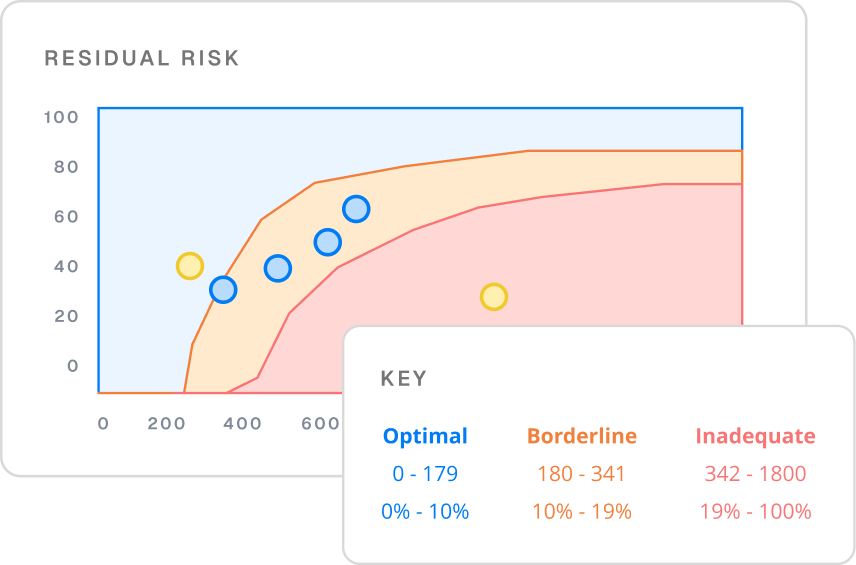
Once every countermeasure has been documented and evaluated, Circadian Risk calculates the residual risk score for every location and every scenario. That score surfaces on the Residual Risk Scoring dashboard, updated automatically as assessments are completed and deficiencies are resolved.
Frequently Asked Questions About Physical Security Controls and Vulnerability Mapping
What is physical security controls and vulnerability mapping?
Physical security controls and vulnerability mapping is the process of documenting every security countermeasure at a location, evaluating each one for compliance or deficiency, and identifying gaps relative to the specific threat scenarios that location faces. Circadian Risk conducts this process visually on an interactive map, scenario by scenario, producing a structured dataset that feeds directly into the residual risk calculation rather than a static written report.
How is Circadian Risk's approach different from a standard security audit?
A standard security audit typically produces a written report documenting observations and recommendations. Circadian Risk’s Controls and Vulnerability Mapping produces a structured, scenario-specific dataset that populates a live platform. Every asset is mapped, classified, and connected to the scenarios it affects. Deficiencies become remediation tasks. The completed mapping does not sit in a folder. It becomes the foundation for ongoing risk monitoring, reporting, and improvement.
Can Circadian Risk support compliance-focused vulnerability assessments?
Yes. The platform supports compliance-focused assessments including healthcare standards such as Joint Commission requirements, financial services standards, K-12 school security standards, and other ASIS International standards. As a partner of ASIS International, Circadian Risk can convert ASIS standards directly into structured assessment frameworks within the platform.
How does the visual mapping interface work in practice?
Assessors load a floor plan or site map for the location being assessed and place countermeasure icons onto the map at their actual positions. Each asset is then evaluated for compliance, deficiency, or absence against the scenario being assessed. The process is faster and more consistent than paper-based or spreadsheet-based methods, and the output is immediately usable for remediation planning and residual risk scoring.
See How Circadian Risk Maps Physical Security Controls and Vulnerabilities Across Your Portfolio
Walk through the Controls and Vulnerability Mapping module with a member of our team. See how your organization’s physical security inventory would look when every asset, every scenario, and every location are connected in one platform.